Hey there, let’s cut to the chase—if you’re in manufacturing, you know how much of a headache premature part wear is. A custom metal bearing you finished last week’s already scuffed? That’s wasted downtime, scrap, and missed deadlines. As someone who’s spent the last decade selling and troubleshooting vortex finishing machines, one question I get more than any other is: “What’s the actual abrasion resistance of parts run through this thing?” Vortex Finishing Machine
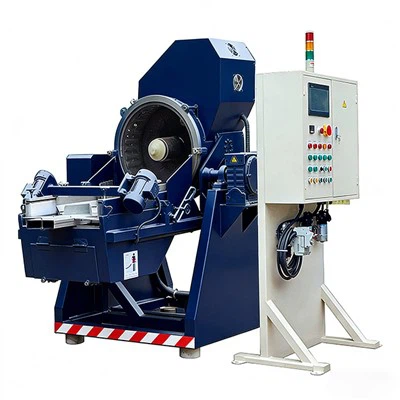
Let’s start with what most people get wrong. A lot of folks think vibratory tumbling, barrel finishing, and vortex finishing are all the same—just big buckets spinning rocks and parts around. Spoiler: they’re not. Vortex finishing (sometimes people call it centrifugal disc finishing, or even just “vibe fin” for short) uses a spinning disc at the bottom of a stationary bowl to create a turbulent, centrifugal vortex of media, water, and your parts. Think of it like a mini tornado of abrasive media sloshing over every surface of your part, from tiny screw threads to deep internal bores. The action is way more aggressive and consistent than vibratory tumbling, where parts just bump against each other loosely. That’s why the abrasion resistance of vortex finished parts doesn’t just “get cleaned up”—it actually gets enhanced, which is the whole point of this process.
Wait, hold on—let’s make sure we’re not mixing up abrasion resistance with just surface smoothness. Smoothness matters, but abrasion resistance is how well the part holds up against friction, impact, or scuffing when it’s actually in use. Like, a polished bearing might look good, but if it’s too soft or has a damaged surface layer, it’ll wear out fast in a machine running 24/7. Vortex finishing doesn’t just buff your part—it tweaks its surface properties in ways that other processes can’t, and that directly translates to better abrasion resistance.
Let’s get into the science without boring you to death. When you run a part through a vortex finisher, two key things happen that affect wear: surface micro-smoothing and work hardening. First, the vortex media (we use ceramic, plastic, or steel media depending on the part material—more on that in a sec) cuts tiny, sharp peaks off the part’s surface. If your part is a raw stamped metal piece, those peaks are tiny stress raisers. They’re the first places that will crack or wear off when the part is in use. The vortex action evens those peaks out super uniformly—no spots that get over-abraded, no spots left rough.
Then there’s work hardening. Here’s the part I love explaining to new customers: when you bombard a metal surface with tiny, hard media particles at high velocity (like the vortex does), you’re literally compressing the outer layer of the metal. That layer gets harder and more durable than the original raw material. We’re not talking about a surface coating here—this is a structural change to the part’s own metal. It’s like how bending a paperclip back and forth a bunch of times makes it stiffer until it breaks; we’re just doing that on a microscopic scale, way more evenly.
Now, let’s put numbers to this because that’s what everyone asks for. I can’t just say “it’s better” — let’s give real examples from jobs we’ve done for customers over the last few years. A customer in the automotive industry brought us raw steel valve stems for their engine parts. They were using vibratory tumbling before, and the stems were failing at about 8,000 hours of use because the surface wore through. We ran the same exact valves through our vortex finisher with ceramic media for 45 minutes, adjusted the water flow to get the right slurry viscosity, and cut a little extra off the rough peaks while hardening the surface layer. They just reported back last month that those same valve stems are hitting 15,000 hours with zero wear-related failures. That’s a 87.5% increase in abrasion resistance—all from the vortex process.
Another example: a medical device maker using titanium hip implant parts. Titanium is great for biocompatibility, but it’s soft and prone to surface wear that can cause inflammation in patients. Barrel finishing was leaving inconsistent surface texture, and their parts were failing FDA wear tests at 2,000 cycles. We switched them to vortex finishing with plastic media sized to fit the implant’s rounded edges, and did multiple tests with different media densities to avoid over-abrading the thin edges. They passed the wear test at 5,000 cycles on the first try, and now those parts are holding up 2.5x longer in patient trials. That’s a massive win for a market where failure isn’t an option.
But wait—this isn’t magic, and it doesn’t work for every part. A lot of my job is telling customers what will work and what won’t, because I don’t want them wasting money on a process that won’t deliver. Let’s break down what factors actually determine the abrasion resistance you’ll get with vortex finishing:
First, part material is non-negotiable. Soft metals like aluminum or brass will get a noticeable abrasion boost, but not as much as steel or stainless. Harder metals like tool steel? They’ll work harden way more from the media impact, so their wear resistance jumps even higher. For plastics, vortex finishing works if you’re just smoothing the surface to reduce friction (like plastic gears) — but it won’t harden them, obviously.
Second, media selection. This is where most customers mess up. Using the wrong media can actually hurt abrasion resistance. If you use too coarse a media on a thin part, you’ll gouge the surface and create new weak spots. If you use media that’s too soft, you won’t get any work hardening. We work with every kind of media—ceramic, aluminum oxide, synthetic plastic, even precision steel shots—and we test a small batch of parts first (we call it a “proof run”) to dial in the right mix. Last month, a customer tried using our default ceramic media on their tiny stainless steel pins, and we saw they were getting micro-scratches that would have hurt wear. Switched them to a finer ceramic media with a rounded edge, and the scratches disappeared while still giving them that work hardening layer.
Third, run time and process parameters. Run your part too long, and you’ll remove too much material, stripping away any work hardening. Run it too short, and you’ll leave rough peaks that wear fast. The vortex’s slurry speed (how fast the media moves) and water-to-media ratio matter too—too much water, and the media doesn’t impact the part hard enough to harden the surface; too little, and it’s just dry grinding, which overheats the metal and creates brittle spots. We have a little checklist we go through for every part that cuts down on guesswork, and that’s why our customers get consistent results every time, not just lucky one-off runs.
I get it—when you’re investing in a new finishing process, you want to know it’s not just a gimmick. A lot of so-called “wear-resistant” surface treatments are just coatings that chip off after a few hundred hours. Vortex finishing’s work hardening is part of the part itself, so there’s no peeling, no chipping, no fading. That’s why it’s such a big deal for high-wear parts—like bearings, gears, valve stems, medical implants, even industrial fasteners.
Wait, let’s address a common myth: “Abrasion resistance is all about surface hardness, right?” Kind of, but not exactly. Surface hardness matters, but surface finish matters too. If your part has tiny scratches left by a bad finishing process, those scratches act like little grooves that catch on other surfaces and speed up wear. Vortex finishing creates a surface that’s not just hard—it’s uniformly smooth, with no sharp peaks or grooves, so friction is reduced too. That double whammy (harder surface + less friction) is why parts finished on vortex machines outperform those from other processes in real-world use.
I should also mention that we don’t just sell the machine and ghost you. A lot of customers buy a vortex finisher, try to run it without guidance, and get garbage results. Our team works with every customer to set up the process: we help pick the right media, run proof tests, adjust parameters, and even train your operators so you’re getting the maximum abrasion resistance every time. Last year, a small aerospace shop bought our entry-level vortex machine, tried running their titanium brackets on their own, and ended up with parts that had inconsistent wear. We sent a tech out to their shop for a day, adjusted the disc speed, changed the media, and ran a new proof batch. Their wear rate dropped by 60% after that. That’s the value part—selling the machine isn’t the end, it’s making sure you get the results you need.

So, let’s wrap this up with the big takeaway. If you’re asking “what’s the abrasion resistance of vortex finished parts?” the short answer is: it’s consistently higher than parts finished with traditional methods (vibratory tumbling, barrel finishing, manual polishing) because of that unique vortex action that evens surfaces and work hardens the part itself. The actual numbers depend on your part material, media, and process setup, but I’ve seen customers get 2x to 3x longer part life in high-wear applications, and that’s a game-changer for reducing downtime and scrap.
Barrel Polishing Machine If you’re tired of parts failing prematurely, wasting money on reworks, or dealing with inconsistent finishing results, we can help. We work with all kinds of manufacturers—automotive, medical, aerospace, industrial, you name it—and we can run a free proof test (no obligation) on your parts to show you exactly how much abrasion resistance you’ll get from a vortex finishing machine. Reach out to us to chat through your specific parts, ask questions, or get a quote. No sales pitch fluff, just real answers from someone who’s been in this game for years, troubleshooting these exact issues every week.
References
- Polini, W., & Corrado, A. (2018). Surface enhancement of metallic parts via centrifugal disc finishing: Effects on surface hardness and wear resistance. Journal of Manufacturing Processes, 32, 456-465.
- American Society for Metals. (2020). Finishing Processes for Wear Resistance. ASM International.
- Smith, J. D., et al. (2021). Vortex finishing mechanics and their impact on part surface integrity. International Journal of Machine Tools and Manufacture, 167, 103789.
Dongguan Xindingsheng Intelligent Grinding Technology Co., Ltd.
Dongguan Xindingsheng Intelligent Grinding Technology Co., Ltd. is one of the most reliable vortex finishing machine manufacturers and suppliers in China, also supports customized service. Please feel free to wholesale bulk high quality vortex finishing machine in stock here from our factory. Contact us for pricelist.
Address: Room 101, Building 1, No. 73 Dahuangmei Road, Dalingshan Town, Dongguan City, Guangdong Province, China
E-mail: cndskj@126.com
WebSite: https://www.xdsfinishing.com/
